


There is something about a lemon blueberry loaf cake that makes a kitchen feel calm. It is not a fussy cake. It does not need layers, frosting, or any special equipment. It is a single loaf, baked in one tin, with a bright lemon flavour, juicy blueberries in every slice, and a simple glaze that sets into a thin, sweet shell. It is the kind of cake you bake on a Sunday afternoon and slice all week, with coffee in the morning and tea in the afternoon, and it somehow tastes better on the second day than it did on the first.
Lemon and blueberry are one of those pairings that just work. The lemon lifts the whole cake, cutting through the sweetness and making the blueberries taste more like themselves. The blueberries, in turn, soften the sharpness of the lemon and add little pockets of jammy sweetness as they bake. Neither flavour shouts. Together they make a cake that tastes fresh and balanced, the sort of thing you can eat a second slice of without feeling weighed down.
This loaf is made with oil rather than butter, which is a deliberate choice. Oil keeps the crumb moist for days, and it means you do not have to wait for butter to soften or worry about creaming it properly. The batter comes together in one bowl with a whisk, and the whole thing is in the oven in about fifteen minutes. If you have ever been put off baking because a recipe asked for three bowls and a stand mixer, this one will be a relief.
One thing worth knowing before you start is that blueberries can sink. It happens to almost everyone at some point, and it is not your fault. The batter is fairly soft, and heavy berries drop to the bottom as the cake bakes. The fix is simple: toss the blueberries in a spoonful of flour before you fold them in. That light coating helps them grip the batter and stay suspended. It is a small step, but it makes the difference between a loaf with berries only at the bottom and a loaf with berries in every slice.
Why You Will Love This Lemon Blueberry Loaf
First, it keeps well. Many cakes dry out by the next day, but this loaf stays moist for three or four days because of the oil and the moisture from the blueberries. In fact, the flavour improves as it sits, because the lemon soaks gently into the crumb. If you bake it on a Sunday, you will still be enjoying it on Wednesday, and that makes it a practical bake as well as a delicious one.
Second, it is versatile. It works as a breakfast cake with coffee, as a lunchbox slice, as an afternoon tea cake, and as a simple dessert with a spoonful of whipped cream or a scoop of vanilla ice cream. You can serve it plain, glazed, or dusted with icing sugar, and it suits all three. It also travels well, which makes it a good choice for picnics, bake sales, and taking to a friend’s house.
Third, it looks lovely with very little effort. The golden top, the deep purple berries peeking through, and the white glaze dripping down the sides make it look like a cake from a bakery, even though you made it in one bowl. If you are baking for guests and want something that looks impressive without being stressful, this loaf is a good answer.
Ingredients for Lemon Blueberry Loaf Cake
You will need a 9 by 5 inch loaf tin, about 23 by 13 cm, lined with baking paper so the loaf lifts out easily. Leave a little paper overhanging the sides to use as handles. If you only have an 8 by 4 inch tin, the loaf will be taller and will need a few extra minutes in the oven, so keep an eye on it.
- 200 g plain flour (all-purpose flour), about 1 2/3 cups
- 200 g granulated sugar, about 1 cup
- 2 teaspoons baking powder
- 1/2 teaspoon fine salt
- Zest of 2 lemons, finely grated
- 3 large eggs, at room temperature
- 120 ml neutral oil, such as vegetable oil or sunflower oil
- 120 ml whole milk or plain yoghurt
- 60 ml fresh lemon juice, about the juice of 1 large lemon
- 1 teaspoon pure vanilla extract
- 180 g fresh blueberries, about 1 1/2 cups, plus 1 tablespoon flour for tossing
- For the glaze: 120 g icing sugar and 2 tablespoons lemon juice
Use fresh lemons rather than bottled lemon juice if you can. The zest is where most of the lemon flavour lives, and bottled juice cannot replace it. When you zest a lemon, use only the yellow part of the skin and stop before you reach the white pith underneath, which is bitter. A microplane grater works best, but the fine side of a box grater will do.
Fresh blueberries are best for this recipe, but frozen blueberries work too. Do not thaw them first; fold them in straight from the freezer, tossed in flour, and add about five extra minutes to the baking time. Frozen berries will tint the batter slightly purple where they touch it, which is normal and looks rather pretty. If you want more blueberry bakes in your collection, our banana bread without butter uses the same one-bowl, oil-based method and stays moist for days.
How to Make Lemon Blueberry Loaf Cake
Preheat your oven to 175°C (350°F) and line your loaf tin with baking paper. In a large bowl, rub the lemon zest into the sugar with your fingertips for about thirty seconds. This releases the oils from the zest into the sugar and makes the whole cake smell wonderful before you have even added anything else. It is a small step that makes a real difference to the flavour, so do not skip it.
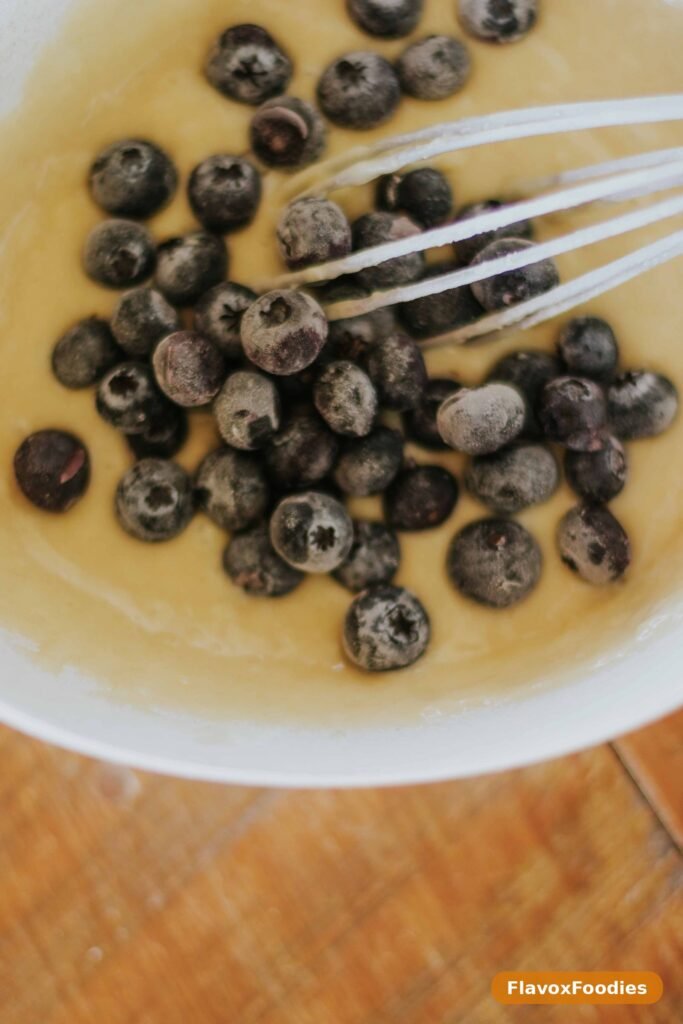
Add the eggs to the sugared zest and whisk until the mixture is pale and slightly thick, about a minute. Then whisk in the oil, milk, lemon juice, and vanilla extract until everything is combined. The mixture will look thin and a little separated at this stage, and that is fine. It will come together once the flour goes in.
In a separate bowl, whisk together the flour, baking powder, and salt. Tip the dry ingredients into the wet ingredients and stir gently with a spatula or wooden spoon until you can no longer see dry flour. Stop as soon as the batter is combined. Overmixing at this point will make the loaf tough, because the flour develops gluten the more you stir it. A few small lumps are fine; they will disappear in the oven.
Toss the blueberries in a tablespoon of flour, shaking off any excess, then fold them into the batter with two or three gentle strokes. Do not stir hard or the berries will burst and turn the batter purple. Pour the batter into the prepared tin and smooth the top. Scatter a few extra blueberries on top if you like, so the finished loaf looks pretty.
Bake for 50 to 60 minutes, until the top is golden and a skewer pushed into the centre comes out clean or with a few moist crumbs. If the top is browning too quickly, loosely cover the tin with a piece of foil for the last fifteen minutes. Every oven is different, so start checking at 50 minutes. A loaf that is underbaked in the middle will sink as it cools, so it is worth being patient and making sure the centre is fully set.
Let the loaf cool in the tin for fifteen minutes, then lift it out using the paper handles and set it on a wire rack to cool completely. Do not glaze it while it is still warm, or the glaze will melt and slide off. Once the loaf is completely cool, whisk the icing sugar and lemon juice together until smooth and drizzle it over the top, letting it drip down the sides. Let the glaze set for about twenty minutes before slicing.
Tips for the Best Lemon Blueberry Loaf
Measure your flour carefully. Too much flour is the most common reason a loaf cake turns out dry, and it is easy to add too much if you scoop straight from the bag. Spoon the flour into your measuring cup and level it off, or better still, weigh it. Two hundred grams is the right amount for this recipe, and a kitchen scale takes the guesswork out of it entirely.
Use room-temperature eggs. Cold eggs do not mix as smoothly into the batter, and they can make the oil seize up into little flecks. If you have forgotten to take the eggs out of the fridge, put them in a bowl of warm water for five minutes and they will be ready. The same applies to the milk; cold milk is fine here, but room-temperature milk mixes in more evenly.
Do not skip the zest. The lemon juice adds tartness, but the zest is what gives the cake its real lemon flavour. Without it, the cake will taste mildly citrusy at best. Two lemons may sound like a lot, but most of that is zest, and the cake needs it. If your lemons are small, use three.
Check the loaf early and trust the skewer test rather than the clock. Ovens vary, and a loaf tin that is dark metal will bake faster than a light-coloured one. The skewer test is the most reliable guide: if it comes out with wet batter, give the loaf another five minutes and check again. If it comes out clean, take it out, even if the timer still has a few minutes left.
Let the loaf cool fully before glazing. A warm loaf will absorb the glaze and the top will look wet rather than white. It will still taste good, but it will not look as neat. If you are in a hurry, you can skip the glaze altogether and dust the cooled loaf with icing sugar instead, which looks just as pretty.
Variations to Try
For a lemon raspberry loaf, replace the blueberries with the same weight of fresh raspberries. Raspberries are softer, so fold them in very gently and expect a few to break. The result is a slightly tarter loaf with a beautiful pink tint where the berries have burst.
For a poppy seed version, add two tablespoons of poppy seeds to the dry ingredients. Lemon and poppy seed is a classic combination, and the seeds add a pleasant crunch and a lovely speckled look to the crumb. This version is especially good with the lemon glaze.
For a streusel-topped loaf, skip the glaze and scatter a crumble made from 40 g flour, 40 g sugar, and 30 g cold butter rubbed together over the top of the batter before baking. The streusel bakes into a crisp, golden topping that contrasts nicely with the soft cake underneath. If you enjoy fruit bakes with a crumbly topping, you will also like our small-batch oatmeal cookies, which use oats in a similar way.
For a dairy-free loaf, replace the milk with oat milk or almond milk and use a dairy-free yoghurt if you prefer the yoghurt version. The loaf will be just as moist. For a slightly richer loaf, replace half the oil with melted butter. The butter version tastes a little more traditional, while the oil version stays softer for longer. Both are good, so choose the one that suits your cupboard.
Serving Ideas

The simplest way to serve this loaf is in thick slices, on their own, with a cup of coffee or tea. The glaze adds enough sweetness that it does not need anything else. It is a good cake for a slow morning, eaten at the kitchen table with the newspaper, or for an afternoon break when you want something sweet but not heavy.
For dessert, serve a slice with a spoonful of lightly whipped cream and a few fresh blueberries on the side. Vanilla ice cream works too, especially on a warm day. A little lemon curd spread on a slice is another lovely option; it doubles down on the lemon flavour and makes the cake feel more like a proper pudding. If you are serving it to guests, arrange the slices slightly overlapping on a long plate, with a few blueberries and a sprig of mint scattered around the edge.
This loaf also makes a thoughtful gift. Bake it, let it cool, wrap it in baking paper and a ribbon, and take it to a friend who has just moved house or is feeling under the weather. It travels well and it keeps, so it is a practical gift as well as a kind one. A loaf cake is one of the oldest forms of care, and this one carries that tradition well.
Storage and Freezing
Store the loaf in an airtight container at room temperature for up to four days. The glaze helps to seal in moisture, so the loaf stays soft. If your kitchen is very warm, you can store it in the fridge, but bring slices back to room temperature before eating, because cold cake tastes less flavourful than room-temperature cake.
To freeze the loaf, let it cool completely and do not glaze it yet. Wrap it tightly in cling film, then in foil, and freeze for up to three months. Thaw it overnight in the fridge or for a few hours at room temperature, then glaze it fresh before serving. You can also freeze individual slices, wrapped separately, so you can take out one slice at a time for lunchboxes.
If a slice feels a little dry after a few days, warm it for ten seconds in the microwave or toast it lightly. A thin spread of butter on a warm slice is surprisingly good, and it brings the cake back to life. For more on keeping baked goods fresh, BBC Good Food has practical advice on storing cakes so they stay moist for longer.
Frequently Asked Questions
Why did my blueberries sink to the bottom?
Blueberries sink when the batter is thin and the berries are heavy, which is common in a soft loaf batter. Tossing the berries in a tablespoon of flour before folding them in helps them grip the batter and stay in place. Using a slightly thicker batter also helps, so do not add extra milk beyond what the recipe calls for. Even if some berries do sink, the loaf will still taste good, so do not worry too much. It is a common problem, and the flour trick fixes it most of the time.
Can I use frozen blueberries instead of fresh?
Yes, frozen blueberries work well. Use them straight from the freezer, without thawing, and toss them in flour just as you would fresh berries. Add about five extra minutes to the baking time, because frozen berries cool the batter down. The batter may turn slightly purple where the berries touch it, which is normal. Do not use thawed berries, because they will release a lot of juice and make the batter wet. If you like baking with frozen fruit, our air fryer chocolate chip cookies are another recipe that works well with ingredients straight from the freezer.
How do I know when the loaf is fully baked?
A skewer or thin knife pushed into the centre should come out clean or with a few moist crumbs, with no wet batter clinging to it. The top should be golden and spring back lightly when pressed. If the skewer comes out wet, bake for another five minutes and test again. Remember that the loaf keeps cooking for a few minutes after you take it out of the oven, so it is better to take it out when the skewer is just clean than to leave it in too long and dry it out.
Can I make this loaf without a loaf tin?
You can bake it in an 8-inch round cake tin instead. The cake will be shallower and will bake faster, so start checking at 35 minutes. You can also use a muffin tin to make individual lemon blueberry muffins; fill each cup about two-thirds full and bake for 18 to 22 minutes. The glaze works on muffins too, drizzled over the top once they are cool. For guidance on swapping tins and adjusting times, King Arthur Baking has a helpful guide to pan sizes and baking times.
Why is my loaf dry?
The most common cause is too much flour, often from scooping directly from the bag and packing it into the cup. Weighing the flour, or spooning it into the cup and levelling it off, will fix this. Overbaking is the other common cause; even five extra minutes can dry out a loaf. Start checking at 50 minutes and take the loaf out as soon as the skewer comes out clean. Using oil rather than butter helps, because oil stays liquid at room temperature and keeps the crumb soft for days.
Can I leave out the glaze?
Yes, absolutely. The loaf is delicious without the glaze, and some people prefer it plain. A dusting of icing sugar is a nice alternative, or you can serve it with a spoonful of lemon curd or whipped cream instead. The glaze adds sweetness and a pretty finish, but it is not essential to the flavour of the cake. If you are taking the loaf somewhere and worry about the glaze melting, leaving it off is the safer choice. For another simple glazed bake, try our small-batch chocolate chip cookies without brown sugar, which need no glaze at all.